
Services
Our expertise at your service
A service provision involves making the skills and expertise of our staff available to institutions, public bodies or private companies.
It is tailored to the client’s specific needs and may be a one-off assignment or part of a longer-term arrangement. This type of activity is one of the tasks entrusted to the universities of applied sciences that are members of the HES-SO, with a focus on knowledge-sharing and the transfer of expertise.
Where can the services be provided?
We provide our services across a wide range of settings:
Hospital services
Outpatient facilities
Home care
Community interventions
What types of services are available?
We offer a wide range of services, designed to support organisations in skills development, improving practices and fostering innovation:
Assignments
Practice analyses
Professional, scientific or educational consultancy assignments
Support for the implementation of new practices
Team support and coaching
Research assignments: evaluative research, literature reviews or scientific reports
Training courses
Short training courses (in-house or external) – bespoke or from our catalogue
Digitisation of your training programmes
Creation of teaching materials (e-learning, guides, reference documents)
Support for the development of innovative training programmes
Who is involved in our service provision?
La Source has 104 teaching and research staff, specialising in nine fields. Their expertise is continually enhanced by applied research and close links with clinical practice.
Services are provided by professors, senior lecturers and experts in the field.
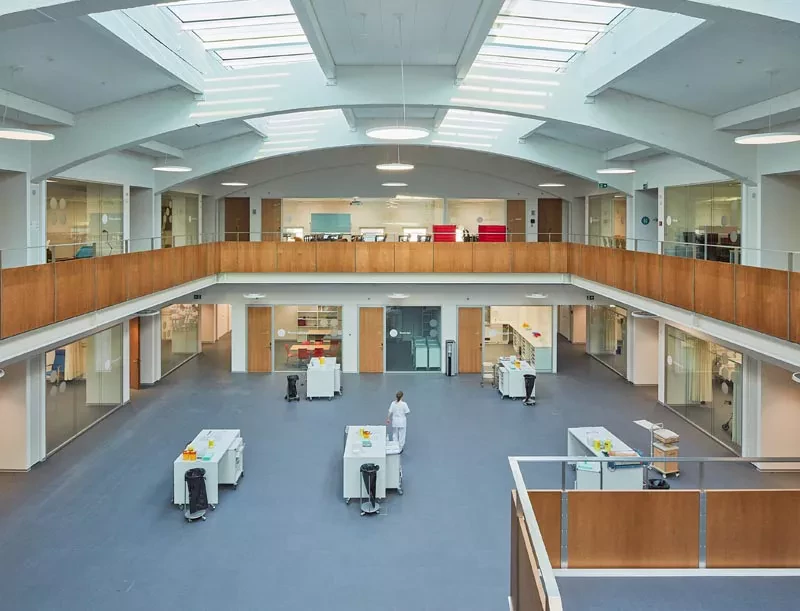
For certain services, bespoke simulations are developed and organised by our teams specialising in the Simulated Hospital. The inclusion of simulated patients enables realistic scenarios and enhanced learning.

What resources underpin the provision of services?
Service provision can draw on the resources and expertise of La Source’s many entities.
Research and Innovation
To drive change in practice through research and to work closely with training programmes.
Find out moreSimulation
Develop essential skills in conditions that closely resemble real-life situations.
Find out moreSimulated hospital
To provide a space for nursing practice where staff can learn in a safe environment.
Find out moreSimulated patients
Training tomorrow’s professionals through practical experience and role-play.
Find out moresenior-lab
Interdisciplinary innovation to improve the quality of life for older people.
Find out moreDiscover our areas of expertise in service provision:
Clinical assessment
Clinical assessment
Adults: a comprehensive assessment, from medical history to physical examination and auscultation
Children: assessment tailored to developmental stages
Older people: screening for frailty and complex needs
Mental health: observation, rapport and understanding of symptoms
Nutritional status: screening and nutritional monitoring
Quality of care and patient safety
Quality of care and patient safety
Handover at the patient’s bedside: effective and secure communication
Scope of nursing practice: optimising roles and competencies
Best practice recommendations: integration and implementation
Partnership with service users: collaboration and empowerment
Practical care for older people
Practical care for older people
Prevention of violence and abuse
Use of advance directives
Psychiatric Care Practice
Psychiatric Care Practice
Psychosocial treatments for schizophrenia
Resources to support recovery and transition
Support for carers
Suicide prevention
Clinical and Organisational Ethics
Clinical and Organisational Ethics
Team support focusing on ethical issues
Training for managers in organisational ethics
Higher Education Pedagogy
Higher Education Pedagogy
Training design
Simulation
Educational games
Interprofessional education
New approaches in line with developments in the healthcare sector
New approaches in line with developments in the healthcare sector
Interprofessional training (doctors, nurses, other healthcare professionals)
Development of non-technical skills (communication, leadership, teamwork)
Data and care management
Patient-centred approaches and optimisation of care pathways
Burnout prevention and team support
Development of nursing leadership
Action research carried out directly within healthcare organisations